
Clean, safe water is an investment, not a guarantee. Whether you manage a manufacturing facility or a residential home, your water treatment system acts as a shield against the hard water, iron, and sediment common in Illinois.
However, a water treatment system is not a “set it and forget it” appliance. Without a proper maintenance plan, resin beds foul, membranes clog, and efficiency plummets.
This guide provides a comprehensive maintenance checklist for residential plumbing basics and commercial systems, helping you extend the life of your equipment and protect your plumbing infrastructure.
Residential Water Treatment Maintenance: The Essential Checklist
Homeowners often ask, “What maintenance does a water filtration system need?”. The answer depends on your specific technology.
1. Water Softener Maintenance (Salt & Resin Care)
Water softeners are the workhorses of Illinois plumbing. To prevent hardness breakthrough and scale buildup, focus on these three areas:
- Salt Bridge Prevention: A hard crust can form at the top of the brine tank, creating a hollow space. Your system may look full, but it’s regenerating with plain water. Action: Test for bridges monthly by gently pushing a broom handle into the salt.
- Resin Bed Cleaning: Iron and manganese can coat resin beads, reducing their ability to attract calcium. Action: Use a resin bed cleaner annually to strip these deposits during the regeneration cycle.
- Venturi Valve Inspection: This valve creates the suction to draw brine. If it clogs with sediment, the system won’t recharge. Action: Clean the venturi and injector nozzle every 12–18 months.
2. Reverse Osmosis (RO) System Service
Reverse osmosis selection is critical for pure drinking water, but these systems rely on pressure and semi-permeable membranes. Neglect leads to TDS creep (Total Dissolved Solids increasing in your product water).
- Pre-Filter Swaps: Sediment and carbon filters protect the delicate RO membrane from chlorine and dirt. Replace these every 6–12 months using high-quality filter technology.
- Membrane Flush: The RO membrane typically lasts 2–3 years. If your water production slows or tastes “flat,” the membrane likely needs replacement.
- Storage Tank Pressure: If you have low flow at the faucet, your storage tank may have lost its air charge. Check the Schrader valve annually.
3. Whole-House Filtration & UV Maintenance
- Sediment Filters: In Illinois, spring rains can increase sediment in municipal and well water. Monitor pressure gauges; a drop in water pressure usually indicates a clogged sediment filter. Consider upgrading to whole-house filtration systems if you experience frequent clogging.
- UV Purification: Ultraviolet light creates safe, bacteria-free water, but the bulb’s intensity fades over time. Replace the UV lamp annually, even if it still lights up, and clean the quartz sleeve to ensure light transmission.
Industrial & Commercial Water Treatment Maintenance Checklist
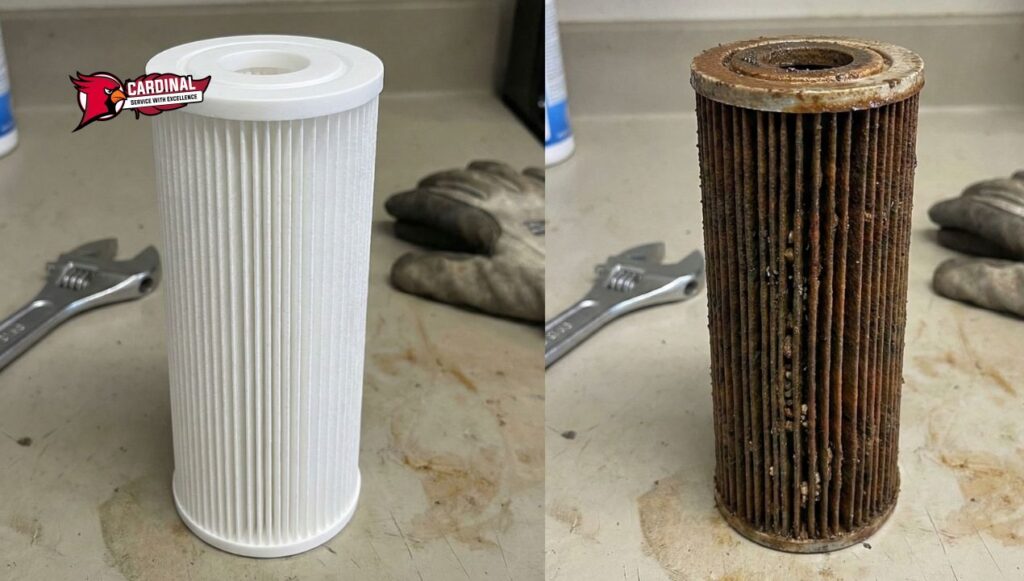
For commercial properties, water treatment serves a critical bottom-line function: protecting capital equipment like boilers and cooling towers. Neglected commercial maintenance planning can lead to expensive downtime.
Daily & Weekly Monitoring
- Check Pressure Differential (Delta P): Record the pressure drop across pre-filters. A sudden spike indicates fouling.
- Monitor Flow Rates: Ensure product water (permeate) and waste water (concentrate) flows match design specs.
- Verify Chemical Feed: Check levels of anti-scalants or biocides and prime dosing pumps.
Monthly & Quarterly Servicing
- Calibrate Sensors: Re-calibrate conductivity, pH, and ORP sensors for accurate dosing.
- Sanitize Loops: Circulate sanitizing agents through distribution piping to prevent biofilm.
- UV Intensity Check: Verify UV sensor readings remain above the alarm setpoint (>85%).
Annual System Audits
- Clean-In-Place (CIP): Perform a chemical cleaning of RO membranes to remove mineral scaling.
- Resin Analysis: Send core samples of softener resin to a lab to check for bead breakage.
- Backflow Testing: Mandatory in Illinois to prevent cross-contamination.
Need a specific plan? We design custom industrial water filtration system maintenance checklists tailored to your facility’s water usage.
Troubleshooting: Signs Your System Needs Service
Recognizing early warning signs can save you from a total system replacement or emergency water heater maintenance.
|
Symptom |
Likely Cause |
Required Maintenance |
|
Water tastes salty |
Clogged injector or drain line |
Clean venturi valve; check drain flow control. |
|
Drop in water pressure |
Clogged sediment filter |
Replace pre-filter immediately. |
|
“Slippery” water feel is gone |
Salt bridge or exhausted resin |
Break salt bridge; run manual regeneration. |
|
Cloudy water / Air bubbles |
Dissolved gas or loose fitting |
Check connections; let system settle if new. |
|
High TDS reading (RO) |
Membrane failure |
Replace Reverse Osmosis membrane. |
Seasonal Maintenance in Illinois
Our local climate affects water quality.
- Winter: Insulate pipes and tanks in unheated areas (garages/basements) to prevent frozen pipes and cracking.
- Spring/Summer: Heavy rains increase agricultural runoff and sediment. You may need to change filters more frequently during these months.
Frequently Asked Questions (FAQ)
What maintenance plans are available?
Many property owners prefer water purification maintenance plans to automate care. We offer scheduled filter changes, salt delivery, and annual performance tuning.
How do I maintain a commercial system?
Commercial systems require stricter adherence to Delta P monitoring and sanitation logs to meet health codes. We recommend professional monthly auditing for these high-volume units.
Can I do the maintenance myself?
Basic tasks like adding salt and changing cartridge filters are DIY-friendly. However, tasks like resin bed re-bedding, valve rebuilding, and RO membrane sanitization generally require professional tools and expertise. For guidance on professional standards, you can refer to the Water Quality Association.
Ready to Protect Your Water System?
Don’t wait for a breakdown. Whether you need a one-time tune-up, a professional drain cleaning service, or a recurring commercial water treatment system servicing plan, Cardinal Plumbing Co. is Illinois’ trusted partner.
We also offer comprehensive water quality analysis to help you understand exactly what is in your water, ensuring it meets Illinois EPA standards.